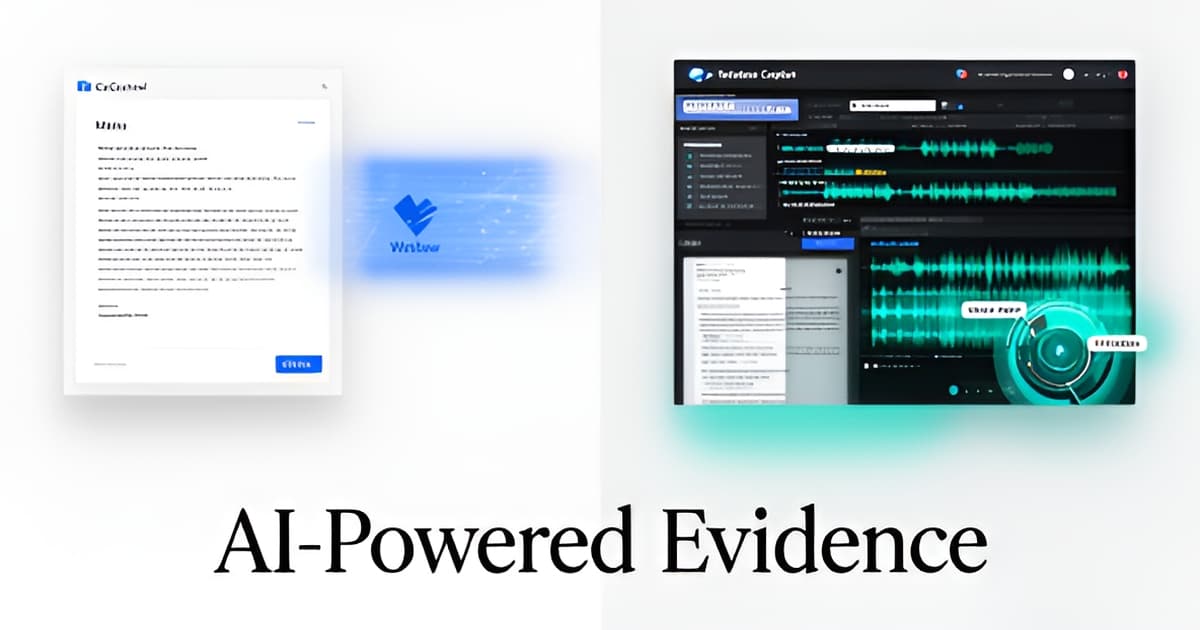
CoCounsel (Thomson Reuters) is a legal-research and memo-drafting AI — reported plans run from $220/mo for Basic Research up to $500/mo for All Access — but it has no workflow for reviewing bodycam video, interrogation footage, jail calls, or 911 audio. Evidence Copilot is the grounded evidence-review alternative for criminal-defense teams, starting at $39/user/mo (Solo, 15 media-processing hours included), with timestamped diarized transcripts, OCR, and AI answers that cite the exact second of video or page of the PDF.
Bottom line: These tools solve different halves of a defense practice: CoCounsel reasons from Westlaw and Practical Law for research and drafting; Evidence Copilot ingests the discovery dump — video, audio, scanned PDFs — and grounds every answer in the evidence itself. For the media-heavy review work that dominates criminal defense, Evidence Copilot is the fit at a fraction of the reported CoCounsel price.
TL;DR
- CoCounsel is research/memo AI: it reasons from Westlaw and Practical Law for case law, drafting, and document analysis — it does not transcribe or review bodycam video, jail calls, or interrogation footage.
- Evidence Copilot is built for the discovery dump: upload video/audio/PDFs up to 2 GB and get timestamped diarized transcripts (Deepgram Nova), OCR'd scanned documents, and an AI evidence agent that answers with clickable citations into the exact video moment or PDF page.
- Reported CoCounsel pricing runs $220/mo (Basic Research) to $500/mo (All Access) per TrustRadius; Evidence Copilot publishes Solo at $39/user/mo (15 media-processing hours), Firm at $99/user/mo (60 hours), and PD Office at $750/attorney/yr (100 hours).
- Evidence Copilot auto-flags candidate inconsistencies on ingest — report vs bodycam, statement vs call audio — as unreviewed review signals before anyone asks.
- CoCounsel's criminal-defense page cites 75+ prebuilt workflows and timeline extraction from documents; Evidence Copilot builds timelines from the actual media, with multi-camera sync across bodycam, dashcam, and interview-room footage.
- Both mark output for human verification: CoCounsel links every source; Evidence Copilot marks every AI output AI-generated and pending review, never makes legal conclusions, and keeps originals immutable.
- Evidence Copilot includes frame-accurate video, audio, image, and PDF redaction with a full audit trail — a workflow CoCounsel does not address.
Head-to-head
| Dimension | CoCounsel | Evidence Copilot |
|---|---|---|
| Pricing | Reported $220/mo (Basic Research) to $500/mo (All Access); On Demand $50–$75 per service; sales-gated | Published: Solo $39/user/mo, Firm $99/user/mo, PD Office $750/attorney/yr; no sales wallwinner |
| Evidence-media review | None — document analysis only | Bodycam, interrogation footage, jail calls, 911 audio, photos, scanned PDFs up to 2 GB per filewinner |
| Transcription & diarization | Not offered | Deepgram Nova, speaker diarization, word-level timestamps, one-click speaker renamingwinner |
| Citations | Linked citations to Westlaw and Practical Law authority | Clickable citations to the exact second of video or page of the PDF |
| Research & drafting | Deep Research, Westlaw Brief Builder, deposition prep, discovery requests, 75+ criminal-defense workflowswinner | Grounded case brief, cross-exam drafts (suggested questions only), Suppression Motion Prep outline, exhibit list |
| Redaction | Not offered | Frame-accurate video, word-level audio, image, and PDF redaction; originals immutable, auditedwinner |
| Criminal-defense fit | Criminal-defense marketing page with document workflows; no evidence-media workflow | Defense-only by design: Miranda timelines, suppression prep, Brady/Giglio research workflow, discovery intake by emailwinner |
| Integrations | Microsoft Word/Outlook/Teams, iManage, NetDocuments, SharePoint, HighQ, Box, Litify, and morewinner | MCP server for Claude Desktop, ChatGPT, Claude Code, Cursor (read-only, OAuth, no tokens); two-way email intake |
| Trial & guarantee | Free trial on request; no published money-back guarantee | 7-day full-access trial (Firm-level, no card); 14-day money-back guarantee on every paid planwinner |
| Human-review posture | Transparent reasoning steps; attorney stays in control of drafts and citations | Every AI output marked AI-generated and pending human review; never makes legal conclusions; originals immutable |
Scores
CoCounsel is Thomson Reuters' legal AI assistant, positioned as 'Fiduciary-Grade AI' that reasons from Westlaw and Practical Law content curated by 1,500+ attorney editors. From a single plain-language query it handles research, analysis, and drafting, showing its reasoning steps with linked citations for verification. Capabilities include Deep Research, Westlaw Brief Builder, Tabular Analysis (up to 10,000 documents against 100 questions), timeline extraction, deposition prep, and discovery request drafting. Thomson Reuters reports CoCounsel is deployed across more than 20,000 law firms and legal departments, including 85% of Am Law 100 firms. For criminal defense specifically, it markets 75+ prebuilt workflows, jurisdiction-specific procedural guidance, and cross-examination outline generation. It integrates with Microsoft Word, Outlook, Teams, iManage, NetDocuments, and other firm tools. It is a document-and-research product: there is no transcription, diarization, video review, or evidence-media workflow.
| Plan | Price | What you get |
|---|---|---|
| CoCounsel On Demand | $50/one_time | $50–$75 per-service pricing |
| Basic Research | $220/mo | Cloud plan; research-focused tier |
| CoCounsel All Access | $500/mo | Cloud plan; full access tier |
Pros
- Reasons from authoritative Westlaw and Practical Law content rather than generic internet training data, reducing hallucination risk in legal research.
- Transparent, inspectable reasoning steps with linked citations so you can verify before relying on an answer.
- Deep, enterprise-grade integrations — Microsoft Word, Outlook, Teams, iManage, NetDocuments — so it works inside existing firm workflows.
- Strong market validation: deployed across 20,000+ law firms and legal departments, including 85% of Am Law 100 firms and courts across the US federal system.
- Genuinely useful criminal-defense document work: summarizing large discovery sets, drafting ROGs/RFPs/RFAs, and building cross-exam outlines from uploaded statements.
Cons
- No evidence-media review: no transcription, speaker diarization, bodycam/jail-call/911 audio workflow, or video citations.
- No published pricing page — plans are gated behind 'View pricing' and sales reps; third-party reported pricing runs $220–$500/mo, which stings for solo defenders.
- Document-centric timelines only — it extracts events from documents, not from the footage and audio the case actually turns on.
- No redaction capability for discovery turnover or client-sharing workflows.
- Positioned for large-firm and enterprise buyers (iManage, NetDocuments, Am Law 100 messaging); the solo/public-defender experience is not the design center.
Evidence Copilot
evidencecopilot.com ↗Evidence Copilot is a grounded evidence-review workspace built specifically for US criminal-defense attorneys, law clerks, defense investigators, and public-defender offices. Upload the discovery dump — bodycam video, interrogation footage, jail calls, 911 audio, police-report PDFs, photos, scanned documents, up to 2 GB per file by web upload or per-case inbound email — and get timestamped diarized transcripts (Deepgram Nova with word-level timestamps and one-click speaker renaming), OCR'd text from scanned PDFs and photo evidence, and an AI evidence agent that answers questions with clickable citations into the exact second of video or page of the PDF. On ingest, every new file is compared against earlier evidence in the case and candidate inconsistencies (report vs bodycam, statement vs call audio) surface as unreviewed review signals. Agent playbooks include Suppression Motion Prep, Miranda Timeline, and Exhibit List Builder. It also handles frame-accurate video redaction, audio redaction by spoken word, multi-camera sync across bodycam/dashcam/interview-room footage, and exports gated by per-member permission. Every AI output is marked AI-generated and pending human review; originals are immutable and every action is audited. The product never makes legal conclusions.
| Plan | Price | What you get |
|---|---|---|
| Solo | $39/mo | Per user, 15 media-processing hours included; full workspace, no feature tiers |
| Firm | $99/mo | Per user, 60 media-processing hours included |
| PD Office | $750/yr | Per attorney per year, 100 media-processing hours included |
Pros
- Purpose-built for the defense discovery dump: bodycam, interrogation footage, jail calls, 911 audio, police-report PDFs, and photos in one workspace.
- Every AI answer cites the exact source moment — the second of video or page of the PDF — and every output is marked AI-generated and pending human review.
- Auto-signals catch candidate inconsistencies between the police report and the bodycam before anyone thinks to ask.
- Published pricing with no sales wall: Solo $39/user/mo, Firm $99/user/mo, PD Office $750/attorney/yr, with overage metered and hard-capped at 3x included hours.
- Full redaction workflow — video, audio, image, PDF — with immutable originals and a complete audit trail, built for defense discovery turnover.
- 7-day full-access trial with no card, plus a 14-day money-back guarantee on every paid plan.
Cons
- Not a legal-research engine: no Westlaw or case-law database, so it won't write your appellate brief or find controlling authority.
- Drafting is deliberately constrained — cross-exam drafts are suggested questions tied to quoted sources, with no credibility conclusions and no legal conclusions, so attorneys still do the strategic work.
- Media processing is metered by hours (15 Solo / 60 Firm / 100 PD Office included), so very high-volume offices need to plan around the cap.
- Defense-only by design — prosecution and law-enforcement use cases are out of scope.
- Cross-case party tracking / prior-instance panels are not available pending bar-ethics review; party mentions work within a case only.
Pricing compared
What each tool actually does with your discovery
Citations, verification, and ethics posture
Which should you pick?
FAQs
Does CoCounsel review bodycam video or jail calls?
No. CoCounsel's skills — Summarize, Review Documents, Search a Database, Tabular Analysis, Timeline — all operate on text documents. There is no transcription, speaker diarization, video player, or audio review. Evidence-media review requires a separate tool like Evidence Copilot, which transcribes bodycam, interrogation footage, jail calls, and 911 audio with word-level timestamps and cites answers to the exact second.
How much does CoCounsel cost compared to Evidence Copilot?
Thomson Reuters does not publish CoCounsel pricing; third-party reported plans run $220/mo for Basic Research and $500/mo for All Access, with an On Demand option at $50–$75 per service. Evidence Copilot publishes its prices: Solo $39/user/mo with 15 media-processing hours, Firm $99/user/mo with 60 hours, and PD Office $750/attorney/yr with 100 hours, plus a 7-day no-card trial and a 14-day money-back guarantee.
Can the two tools be used together?
Yes, and they complement each other. A common defense workflow is Evidence Copilot for the discovery dump — transcripts, inconsistency signals, cross-exam questions, suppression outlines grounded in the footage — and CoCounsel for the legal-research memo on controlling authority. Evidence Copilot also exposes an MCP server so you can query cases read-only from Claude Desktop, ChatGPT, Claude Code, or Cursor if you want to pull evidence excerpts into a broader research workflow.
Which tool is better for cross-examination prep?
It depends on the source. CoCounsel generates cross-exam outlines from uploaded documents — for example, topics and questions for questioning an interviewing officer about a hospital statement. Evidence Copilot drafts cross-exam questions from a review signal with both sides' quotes — the report's claim versus what the bodycam shows — with every question tied to a quoted source and no credibility conclusions. If the impeachment is report-vs-footage, Evidence Copilot's grounding in the media itself is the stronger starting point.
Does either tool make legal conclusions?
No. Evidence Copilot explicitly never makes legal conclusions: every AI output is marked AI-generated and pending human review, cross-exam drafts are suggested questions only, and redaction suggestions are never auto-applied. CoCounsel emphasizes that the attorney stays in control — reviewing facts, choosing arguments, and validating drafts and citations — and positions its AI as enhancing professional judgment rather than replacing it.
What happens if I exceed my media-processing hours on Evidence Copilot?
Overage is metered and hard-capped at 3x your included hours, so a runaway discovery intake cannot overbill you. If a trial lapses, processing pauses but your cases and files stay accessible. Every plan includes the full workspace — there are no feature tiers — and a 14-day money-back guarantee applies to every paid plan.
Sources
- Evidence Copilot — grounded evidence review for criminal defense
- CoCounsel Pricing 2026 — TrustRadius
- CoCounsel Legal — AI Legal Assistant | Thomson Reuters
- Explore Plans — CoCounsel Legal | Thomson Reuters
- Explore Features — CoCounsel Essentials | Thomson Reuters
- AI for criminal defense lawyers with CoCounsel Legal | Thomson Reuters
- AI for criminal law practitioners — Thomson Reuters blog
- How CoCounsel Legal delivers AI legal research you can trust — Thomson Reuters blog