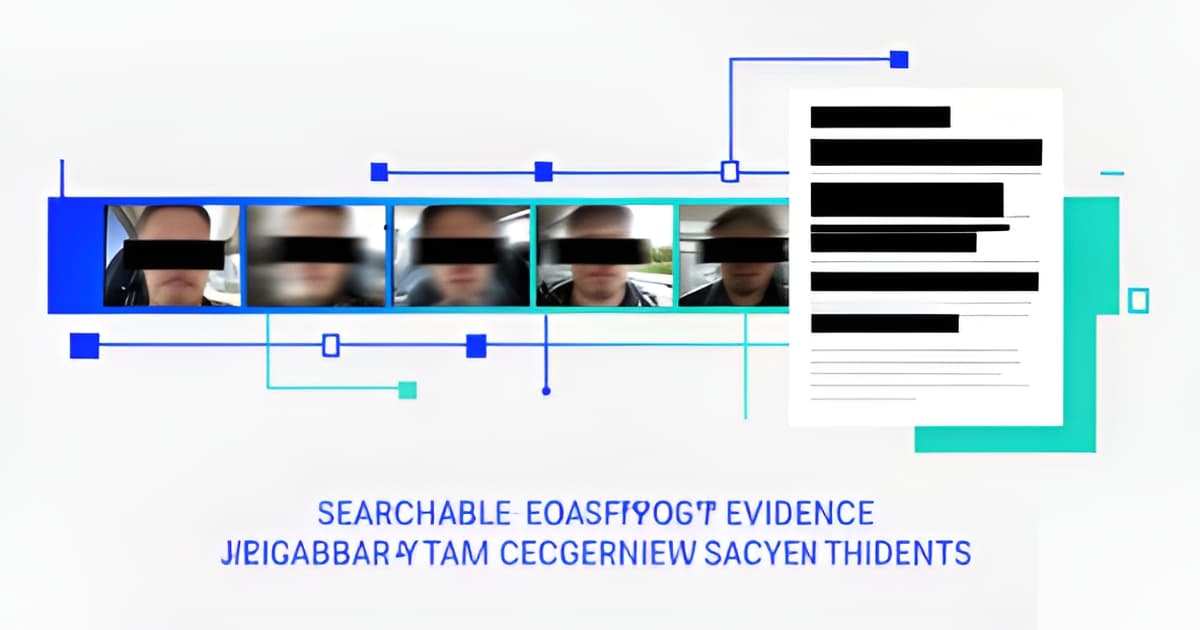
CaseGuard is an AI redaction studio built mainly for police departments, schools, and FOIA/compliance teams — it redacts faces, license plates, and PII across video, audio, documents, and images, but it is not a defense evidence-review workspace. Evidence Copilot is the defense-side alternative: a grounded evidence-review workspace at $39/user/mo (Solo) where every AI answer cites the exact second of video or page of the PDF, with diarized transcripts, OCR, redaction, multi-camera sync, and suppression/Miranda playbooks. If your job is bulk FOIA-style redaction, CaseGuard fits; if your job is reviewing discovery and building motions, Evidence Copilot is purpose-built for that.
Bottom line: For US criminal-defense work — reviewing bodycam, interrogation footage, jail calls, and police reports, then drafting suppression motions and cross-exam questions — Evidence Copilot is the stronger fit because it is a defense evidence-review workspace with cited AI answers and published per-user pricing. CaseGuard remains the stronger pick for high-volume redaction-only workflows serving police, FOIA, and compliance buyers.
TL;DR
- CaseGuard is an AI redaction studio whose core buyers are police departments, prosecutors' offices, schools, and government FOIA/compliance teams — its testimonials skew heavily law-enforcement.
- CaseGuard sells four suites (Doc, Media, Ultimate, Enterprise) on quote-based subscription pricing, with unlimited redactions and file uploads, 900+ supported file types on the top suite, and an on-premise option including air-gapped networks.
- CaseGuard does redaction, transcription, translation, and enhancement — it is not a defense evidence-review workspace; there is no cited AI evidence agent, inconsistency detection, or motion-prep tooling.
- Evidence Copilot is built for US criminal defense: upload bodycam, interrogation footage, jail calls, 911 audio, and police reports, and get diarized transcripts, OCR'd documents, and AI answers cited to the exact video second or PDF page.
- Evidence Copilot publishes its pricing: Solo $39/user/mo (15 media hours), Firm $99/user/mo (60 hours), PD Office $750/attorney/yr (100 hours), with overage hard-capped at 3x included hours and no feature tiers.
- Evidence Copilot's redaction is frame-accurate and audited, with AI-suggested regions filed as review cards — nothing auto-applied; originals are never modified.
- Evidence Copilot is the only defense-side tool in this set with an MCP integration, letting attorneys query cases from Claude Desktop, ChatGPT, Claude Code, or Cursor via a no-token OAuth flow.
Head-to-head
| Dimension | CaseGuard | Evidence Copilot | JusticeText | Reduct | Vidizmo | CoCounsel by Thomson Reuters | Sonix | Casefleet |
|---|---|---|---|---|---|---|---|---|
| Pricing | Quote-based subscription across Doc, Media, Ultimate, and Enterprise suites | Solo $39/user/mo; Firm $99/user/mo; PD Office $750/attorney/yr — published, no feature tierswinner | Reported ~$1,200/attorney/yr | Not published in this comparison | Not published in this comparison | Reported ~$400/user/mo | Not published in this comparison | Not published in this comparison |
| Core focus | AI redaction studio for FOIA/compliance buyers | Grounded evidence-review workspace for criminal defensewinner | Legal transcription | Video transcription and clip extraction | Agency evidence management | Legal research and memo AI | Generic transcription | Case management and timelines |
| Transcription | AI transcription and translation in 100+ languages, tied to redaction | Deepgram Nova diarized transcripts with word-level timestamps and speaker renamingwinner | Core feature; quality complaints reported | Core feature; misses specialized legal terms | Part of evidence management | Not an evidence-media transcriber | Core feature, generic | None |
| Redaction | Deepest coverage: video, audio, documents, images, email; unlimited; on-premisewinner | Frame-accurate video/audio/image/PDF redaction, audited, AI suggestions as review cards | None | None | Redaction included | None | None | None |
| AI citations & audit trail | Automatic audit reports and user logs for redaction actions | Every AI answer cites the exact video second or PDF page; originals immutable; all actions auditedwinner | None | None | Agency audit features | Research citations, not media citations | None | Fact-to-source links |
| Defense workflow tooling | None — redaction-first | Suppression Motion Prep, Miranda Timeline, Exhibit List Builder, cross-exam drafts, inconsistency signalswinner | None | None | None for defense | Research/memo drafting only | None | Timelines and fact organization |
| Integrations | Third-party integrations on Ultimate Suite | MCP server for Claude Desktop, ChatGPT, Claude Code, Cursor; two-way email intakewinner | None noted | None noted | Agency integrations | Thomson Reuters ecosystem | Export-oriented | None noted |
| Deployment & security posture | On-premise including air-gapped networks; metadata scrubbed; permanent redactionswinner | Cloud workspace; originals immutable; AI output marked pending human review; no certifications advertised | Cloud | Cloud | Agency-grade deployment | Enterprise cloud | Cloud | Cloud |
Scores
CaseGuard
caseguard.com ↗CaseGuard is an AI-powered redaction and investigation platform covering video, audio, documents, images, and even email (PST, msg, eml) files. Its headline capabilities are automatic redaction of faces, license plates, screens, names, and other PII, AI transcription and translation in 100+ languages, and 30+ investigator tools for enhancing footage and detecting objects. It sells three product suites — Doc Suite (documents/images), Media Suite (video/audio), and Ultimate Suite (everything plus batch processing, collaboration, and integrations) — plus an Enterprise tier starting at 10+ seats, all on quote-based subscription pricing with unlimited redactions and file uploads. CaseGuard runs on-premise, including air-gapped networks, generates automatic audit trails and compliance reports for FOIA, GDPR, HIPAA, and CJIS contexts, and scrubs metadata on export. Its published customer base is dominated by police departments (Pine Bluff, Fort Wayne, University of Arizona), sheriff's offices, prosecutors, school districts, and county governments, with occasional legal-firm use for demand packages. The company claims up to 88% time savings and 32x faster redaction turnaround versus manual review.
Pros
- Deepest redaction coverage in the set: video, audio, documents, images, and email files, with 900+ supported file types on the Ultimate Suite
- Unlimited redactions and file uploads on every plan, with no per-minute metering
- On-premise and offline-mode deployment for agencies that cannot send media to the cloud
- Automatic audit trails and compliance reports aligned to FOIA, GDPR, HIPAA, and CJIS workflows
- Bulk processing at scale — thousands of files at once — with reported 32x faster turnaround and up to 88% time savings
- Dedicated account managers, live training, and priority support on higher tiers
Cons
- Buyer base is police, FOIA, and compliance teams — the workflow is redaction-first, not defense evidence review
- No cited AI evidence agent, no report-vs-bodycam inconsistency signals, no suppression or Miranda playbooks
- Quote-based suite pricing rather than published per-seat numbers
- Transcription exists to support redaction, not as a citable, diarized review transcript tied to case facts
- No MCP or AI-assistant integration for querying case evidence
Evidence Copilot
evidencecopilot.com ↗Evidence Copilot is a grounded evidence-review workspace built specifically for US criminal-defense attorneys, law clerks, defense investigators, and public-defender offices. You upload the discovery dump — bodycam video, interrogation footage, jail calls, 911 audio, police reports, photos, and scanned documents — and get timestamped, diarized transcripts (Deepgram Nova with word-level timestamps and one-click speaker renaming), OCR'd text from scans and photo evidence, and an AI evidence agent whose every answer carries clickable citations into the exact second of video or page of the PDF. On ingest, new files are compared against earlier evidence and candidate inconsistencies (report vs bodycam, statement vs call audio) surface as review signals. Playbooks draft suppression-motion outlines, Miranda timelines, and exhibit lists with both sides quoted and cited. Redaction is frame-accurate and audited, with AI-suggested regions filed as review cards and originals never modified. Multi-camera sync links bodycam, dashcam, and interview footage to one master clock. Exports include exhibit packs with a citation manifest. An MCP server lets attorneys query cases read-only from Claude Desktop, ChatGPT, Claude Code, or Cursor. Every AI output is marked pending human review; the product never makes legal conclusions.
| Plan | Price | What you get |
|---|---|---|
| Solo | $39/mo | Per user; 15 media-processing hours included; full workspace, no feature tiers |
| Firm | $99/mo | Per user; 60 media-processing hours included; full workspace, no feature tiers |
| PD Office | $750/yr | Per attorney per year; 100 media-processing hours included; full workspace, no feature tiers |
Pros
- Every AI answer cites the exact source moment — you can verify against the video or PDF in one click
- Published, per-user pricing with the full workspace on every plan and no feature tiers
- Defense-native workflows: suppression motion prep, Miranda timelines, cross-exam drafts tied to quoted sources
- Inconsistency signals surface report-vs-bodycam conflicts before you think to ask
- Overage is hard-capped at 3x included hours, so runaway intake cannot overbill
- MCP integration for Claude and ChatGPT — no other defense-side tool offers it
Cons
- Defense-only by design — prosecutors and agencies need a different tool
- File uploads cap at 2 GB per file via web or email
- Media processing is metered by hours, so very high-volume shops should size their plan
- No SOC 2 or security certifications advertised yet — current security posture is stated honestly rather than certified
JusticeText
JusticeText is a transcription-focused tool aimed at legal teams, with particular traction among public defenders and defense attorneys who need bodycam, interrogation, and jail-call audio turned into text. Its core value proposition is legal transcription of evidence media. Compared with a full evidence-review workspace, it is narrower: the workflow centers on producing transcripts rather than on cited AI analysis, inconsistency detection, redaction, or motion-prep tooling. It has no published G2 review presence, which makes third-party validation thin. Reported pricing runs roughly $1,200 per attorney per year. Reported user complaints focus on transcription quality, which matters in this practice area because a mis-transcribed custodial interrogation or jail call can change the read of an entire case.
| Plan | Price | What you get |
|---|---|---|
| Per attorney | $1200/yr | Reported annual per-attorney pricing |
Pros
- Focused specifically on legal transcription rather than generic audio
- Known among defense practitioners, particularly in the public-defense community
- Transcription-first workflow is simple to adopt
Cons
- Reported transcription-quality complaints
- No published G2 presence for third-party validation
- Roughly $1,200/attorney/yr — about 38% more than Evidence Copilot's $750/attorney/yr PD tier
- No redaction, inconsistency signals, or motion-prep playbooks
Reduct
reduct.video ↗Reduct is a video transcription and clip-extraction platform. Its workflow is built around turning recorded video into searchable, quotable text and pulling clips for storytelling or review — a general-purpose media tool used by journalists, researchers, and legal teams alike. For defense work, it covers the mechanical layer: upload footage, get a transcript, highlight and extract the moments that matter. It is not defense-specific: it has no discovery-oriented evidence inventory, no inconsistency signals comparing a police report against bodycam, no redaction pipeline, and no motion or cross-exam tooling. A known limitation is that its transcription misses specialized legal terms, which is a real cost when transcripts of custodial interrogations or suppression hearings feed directly into work product.
Pros
- Clean video-to-transcript-to-clip workflow
- General-purpose flexibility across media types and use cases
- Good fit for pulling exhibit clips from long footage
Cons
- Transcription misses specialized legal terms
- No defense workflow: no evidence inventory, inconsistency signals, redaction, or motion tooling
- Not built around citations into source media for legal verification
Vidizmo
Vidizmo sells AI evidence management and redaction to agencies and law-enforcement organizations. It handles large evidence repositories, redaction, and media workflows at institutional scale — but its buyer is the agency, not the defense team. For a criminal-defense practitioner, that orientation matters: you receive Vidizmo-processed discovery from the prosecution side rather than working inside the platform yourself, and its feature set is not shaped around defense tasks like Brady review, suppression prep, or building a cited case narrative. Defenders forced to work with prosecution-side platforms often report slow players and no analysis tooling; Vidizmo sits in that agency-evidence category rather than the defense-workspace category.
Pros
- Institutional-scale evidence management and redaction
- Established in agency and law-enforcement procurement channels
Cons
- Sells to agencies and law enforcement, not defense workflow
- Defenders consume its outputs rather than work in it
- No defense-specific analysis, citations, or motion tooling
CoCounsel by Thomson Reuters
CoCounsel is Thomson Reuters' AI assistant for legal research, document review, and memo drafting. It is strong at the research-and-writing layer of litigation practice: querying case law, summarizing documents, and producing drafts. What it does not do is evidence-media review — there is no bodycam transcription workspace, no diarized interrogation transcripts, no video-cited answers, and no redaction. At roughly $400 per user per month, it is a significant line item, and defense teams that buy it typically still need a separate tool for the discovery-media half of the case. It is best understood as a complement to an evidence-review workspace rather than a substitute for one.
| Plan | Price | What you get |
|---|---|---|
| Per user | $400/mo | Reported per-user monthly pricing |
Pros
- Backed by Thomson Reuters' legal research corpus
- Strong research and drafting assistance for litigation
- Enterprise-grade vendor support
Cons
- No evidence-media review: no transcription workspace, video-cited answers, or redaction
- Roughly $400/user/mo — a large premium over defense evidence-workspace pricing
- Research/memo focus leaves the discovery-media workflow unassembled
Sonix
Sonix is a generic automated transcription platform: upload audio or video, get a transcript with timestamps, edit it in a browser editor, and export. It is fast and inexpensive per minute, and for a one-off interview or a short 911 call it can be a reasonable stopgap. Its limits show at case scale: there is no diarization quality-control workflow tuned to interrogations, no citations tying statements back to source media, no redaction pipeline for discovery turnover, and no audit trail suitable for evidence handling. Defense teams using Sonix end up stitching together a DIY stack — transcript exports, a separate media player, manual cross-referencing — which is exactly the workflow that breaks down when a case involves dozens of bodycam files and hours of jail calls.
Pros
- Fast, inexpensive generic transcription
- Simple to adopt for one-off files
- Broad file-format support
Cons
- No diarization QC tuned to custodial interrogations
- No citations, redaction, or audit trail for evidence handling
- Breaks at case scale — the DIY-stack problem
Casefleet
Casefleet is case-management software with strong timeline and fact-organization capabilities. Attorneys use it to structure the elements of a case, link facts to sources, and build chronologies — genuinely useful for organizing a defense. Its gap for evidence-heavy criminal cases is media: Casefleet has no media transcription, so bodycam footage, interrogation recordings, and jail calls stay outside the tool. Teams that adopt it typically pair it with a transcription or evidence-review product, importing summarized facts rather than working from the media itself. It is a complement in a defense stack, not a replacement for an evidence-review workspace.
Pros
- Strong timeline and fact-to-source linking
- Useful for organizing case elements and chronologies
- Complements rather than duplicates evidence tooling
Cons
- No media transcription — video and audio evidence stay outside
- Requires a separate evidence-review tool for discovery media
- Not built for the media-heavy reality of modern felony discovery